

polysecure seeking same
on jessica fern's 'Polysecure,' attachment, & nonmonogamy
It was late December 2021, and I was heartbroken from back to back breakups with two of the three Aquarians I was dating. For months I’d been hearing about this new book on polyamory and attachment theory, and I finally caved and went to the bookstore to get a copy. I didn’t know what my attachment style was then, just that it probably wasn’t a good one. I needed this book to fix me. I needed to become Polysecure.

Here’s how author Jessica Fern defines the term she coined:
“The state of being both securely attached to multiple romantic partners and having enough internal security to be able to navigate the structural relationship insecurity inherent to nonmonogamy, as well as the increased complexity and uncertainty that occurs when having multiple partners and metamours.”
Or, “Having secure attachment with yourself and your multiple partners.”
If you put polyamorous people in a room, it’s only a matter of time before someone brings up Polysecure. It’s thought of as Attached meets The Ethical Slut, but sadly there’s nothing slutty about it. Unsuspecting people dive into it after hearing it’s THE polyamory book you need to read, only to discover that the first third of the book is dry attachment theory and trauma frameworks. The flowcharts and diagrams don’t exactly call to mind hot sex with new people.
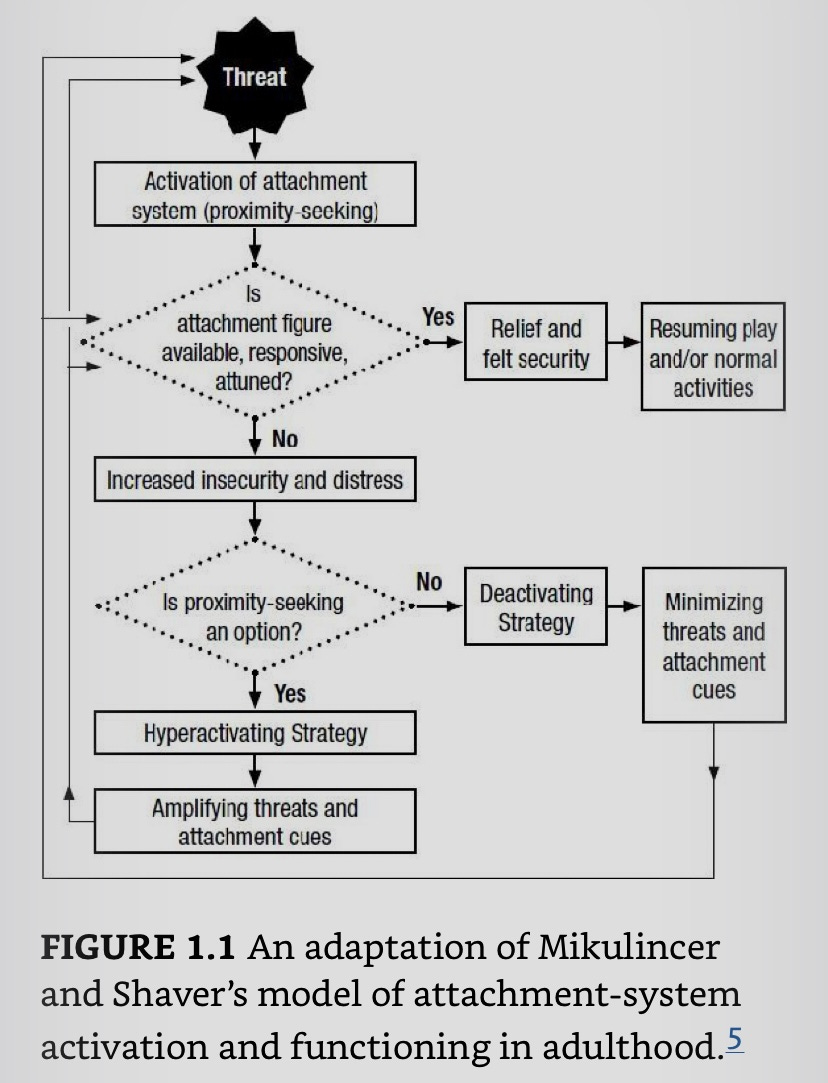
Over the past several years, attachment theory has gotten the pop psych treatment alongside things like parts work therapy (#InnerChildHealing) and somatic therapy (if I see one more meme about the body keeping the score…). The Canva carousels practically create themselves! These posts are all over Instagram, often with this book cited as a reference.
When Polysecure comes up on a date, you can tell how it’s going by whether someone mentions their polycule or their childhood next. If they bring up the partner that’s reading their copy now, you’ve still got a chance. If they start talking about how they developed avoidant attachment though, you’re probably getting that “I had a nice time but I’m just feeling friend vibes” text later.
Unfortunately, as a lesbian and as someone who dates nonmonogamously, I couldn’t get by without a working knowledge of attachment theory. Have I told someone I was working on my secure attachment in the hopes of getting into bed with them? I don’t know for sure, but probably.

I like to think that I’m pretty polysecure these days, but honestly I do have anxious attachment tendencies that come out sometimes. I’ve dated a few people who have an avoidant attachment disposition, and when someone gets avoidant my anxiety ratchets up. It’s a downward spiral because then I want reassurance that they’re still into me, but that can come off as needy and annoying, which makes them want more space. Then I feel like I’m Too Much and get more insecure, and on and on.
It’s so vulnerable to feel like I want someone more than they want me, or I care about someone more than they care about me. It quickly becomes this bigger, deeper thing for me too that can’t be written off easily. It’s not just, This person doesn’t like me, oh well — other people probably will. It’s more like, If they don’t like me, I must not deserve love! Why am I so needy and why do people want so much space from me? Of course they don’t like me — who would?
Avoidant attachment tendencies have come up in enough of the people I’ve dated that I wonder if I’m drawn to that attachment style for some reason, or if something about me brings that out in people.

I’ve become more understanding of their avoidance over time, though, because I can better recognize now that it’s not a way they intentionally chose to relate to me or others. I judge avoidant people less now because many of them have told me they wish they experienced secure attachment more often too.
I still don’t fully understand what goes on in someone’s head when their avoidant attachment flares up though. I should ask the next person I date.

Polysecure is an attachment book for depressed people, and that’s a good thing. It has a helpful, if unstimulating, overview of attachment theory and how the different styles can manifest in adults. Fern also discusses trauma in the context of polyamory, which is useful because of the trauma that nonmonogamy can cau– I mean, because of how trauma can impact nonmonogamous people in unique ways.
It reads like a polyamory book for monogamous people though. That’s not to say people who are already practicing nonmonogamy in some form wouldn’t benefit from reading it; I took some helpful things away from it myself when I reread it recently. I just think that monogamous people are the ones who could get the most out of the book. This seems to be who the intended audience is, too, given that the consensual nonmonogamy (CNM) content in part two is very much a Poly 101, with so much of its focus being on relationships that are opening up. If you’ve already read other CNM books or waded into the poly waters, there’s not much new here for you.
Most people could probably take at least something away from the chapters about relationship skills in part three though. Here, Fern uses the acronym HEARTS, which represents “the different ingredients, skills, capacities, and ways of being for secure functioning in multiple attachment-based partnerships”:
Here (being here and present with me), Expressed delight, Attunement, Rituals and routines, Turning towards after conflict, and Secure attachment with self.
If you have at least some relational intelligence and relationship experience, HEART (singular) is more of a helpful refresher presented in the context of nonmonogamy than groundbreaking principles or an innovative framework. If you’re newer to relationships however, this section could be worth spending some time with.

There are some important things to keep in mind about attachment theory that Fern shares early on in the book. She clarifies that attachment styles aren’t rigid identities, and they don’t describe all of who you are. They’re not static either; she writes about how it’s quite possible to experience secure attachment in relationships, even if you have a history of insecure attachment. Overall, she makes it clear that attachment theory is just a lens, and it doesn’t offer a personality type, a diagnosis, or an excuse for bad behavior. (I’ll probably keep using it this way though.)
As for the book’s popularity among queer folks, there are only a couple mentions of queerness and transness in Polysecure, mostly where Fern wants to compare the process of coming out as nonmonogamous to coming out as queer:
“We also know not to tell a person who is struggling with the realities of coming out as lesbian, gay, bisexual, or transgender that they should just go back to being straight or go back to being their birth gender since being LGBT in a mostly straight and gender-binarized world is just too hard. But when it comes to CNM, our well-intentioned friends, family, and even helping professionals do not necessarily know better and they can be quick to point the finger at CNM as the problem.”1
Additionally, the statistics cited in the book are about straight, presumably-cis couples, with the exception of one study of only 179 gay, presumably-cis men. Fern does call attention to the fact that there is a shortage of studies to reference. But still, I’m not sure how the book seems to have earned must-read status among queer poly folks because it’s hardly for or about us — it doesn’t actually speak to or cite our experiences directly.
Queerness is only mentioned to make weak points of comparison, and the word “queer” doesn’t even appear in the book. This is all a little surprising honestly since Fern herself is bi. I’m curious to find out if she discusses polyamory among queer folks in her 2023 follow-up, Polywise, especially given that queer people are more likely to be nonmonogamous.
Either way, queer people and straight people face similar challenges in the wilds of open relationships. Regardless of your identities, it’s not unlikely that you’ve occasionally questioned whether nonmonogamy is worth the unique, unparalleled headaches and heartbreaks. I know I have.

From personal experience as well as anecdotally, someone reading Polysecure isn’t necessarily a predictor of more ethical nonmonogamy. (It feels extra special being ghosted by people with ENM in their dating app bios, trust me.) It does show a desire to Do The Work at least, but The Work — as if I’m qualified to say this — doesn’t start and end with slogging through this book.
Ultimately though, the takeaways from the book are less a blueprint for how to open up a relationship or how to ethically date and hook up, and more about self-understanding and self-improvement. Yawn!
The book is also more geared toward folks who want to practice polyamory specifically, as opposed to nonmonogamy more broadly. (Polyamory as in the consensual practice of, or desire for relationships with more than one partner at the same time; nonmonogamy being the umbrella term for all types of relationships that aren’t monogamous.2)
It’s there in the definition of “polysecure” too: “multiple romantic partners.” This is an impression an ex of mine shared with me while she was completing the Polysecure workbook with her girlfriend. She said from what she read in the book, and from the contents of the workbook especially, Polysecure seems most relevant for people who have, or want, multiple attachment-based partnerships. Partnerships with people who, to borrow two unnecessarily distinct concepts from the book, may be a safe haven and a secure base for them.
My ex found the workbook helpful overall because that’s the type of partnership she and her girlfriend have. I agreed with her takeaway and we talked about how this doesn’t apply as much to someone like me, who for a while now has generally wanted to keep things casual in dating.3
I also agree with what a different ex told me her therapist said about the book: if you’re going to read only one chapter from Polysecure, it should be the one about secure attachment with oneself, chapter nine.
“You must be a priority in your own life.” “Life occurs in the present moment and our healing needs the fullness of our attention in the here and now to take place.” Good stuff! That chapter’s Attuning to Yourself section on preoccupied attachment — the label no one uses for anxious attachment in adults — made me feel seen.
But overall, the emphasis of Polysecure is on the work you can do yourself to increase secure functioning in your relationships. This makes sense in a way because it’s a self-help book and people are drawn to it for that reason. They come to it looking for guidance around questions like what attachment tendencies do I have, what patterns play out in my relationships, how can I become more secure, and how can I be a better partner. It was written by a therapist, and it takes a therapist’s approach through its focus on self-reflection and self-improvement.
This has its limits however because sometimes we are not the problem! Self-help isn’t all that helpful when we aren’t the one who needs to change.
Nowhere in Polysecure does it say to give the book to your partner and ask them to read it instead because that’s not how therapy or most self-help material works. It’s irresponsible, though, of books like this to frame attachment insecurity as something you can resolve on your own, and to suggest that if you just change something within yourself then you can feel secure, regardless of whether the conditions of your relationship make secure attachment realistic.
“Attach” is a transitive verb, requiring an object for the subject to attach to. Attachment is contextual and affected by the reality of the relationship you’re in.
So, if no one else has said it to you yet: you might not be the problem! Consider that maybe, yes, you could keep your side of the street clean and learn how to approach relationships in a more secure way, but maybe your partner’s side of the street is messy as hell!
Maybe the ways they’re treating you are not okay, and maybe that’s significantly contributing to the insecure attachment issues that come up for you. Or at the very least, maybe they could try to apply the HEART principles better, and try to be more present, more attuned, and more delighted in you.
You deserve better — tell them a mean lesbian from the internet said so! And if your friends are telling you the harsh truth that this person might not actually like you very much4 — if they wanted to, they would, etc — well, then you definitely deserve better.

To my fellow anxious attachment girlies: maybe you don’t need to try to care less or feel less; maybe your partner should just be less avoidant! When they’re being hot-and-cold, withdrawn, or noncommittal, that can be a valid reason to feel anxious. Just as polyamory content is right to highlight that jealousy5 is an okay emotion to feel, it should be pointed out more often that it’s okay to sometimes feel attachment anxiety. Both can signal unmet needs and conversations to be had.
Plus, it’s probably pretty understandable you’re feeling that way! It makes sense to need reassurance if someone who ostensibly likes you back barely texts or calls you, won’t make time for you, asks for more and more space, struggles with commitment, and/or shuts down when you have conflict. You might not be able to make yourself feel securely attached if your partner gives you little reason to be. And if they won’t try to change and things aren’t feeling better, maybe you should stop seeing them! You will be okay, I promise!

Get a copy of Polysecure if you’re horny for attachment theory; if you’re fantasizing about opening up your relationship because you’re bored of the sex or the conversations you have; if your partner wants to open up the relationship and you’re worried it’s because they’re bored of the sex or the conversations you have; if you want a book to read in public to flag that you’re in therapy in a hot girl way; if, on that note, fifty minutes once a week isn’t enough therapy for you; if you’re looking for a conversation-starter to have on your nightstand for when a date comes over; or if you’re curious about what goes on in the polyamorous bedroom and you want a disappointing answer: a whole lot of talking about our feelings.
But first think about whether the conflict or challenges with a partner might actually come from them, or exist within the relationship itself. If that feels true, put the book down. Maybe there isn’t something wrong about yourself that you need to fix.
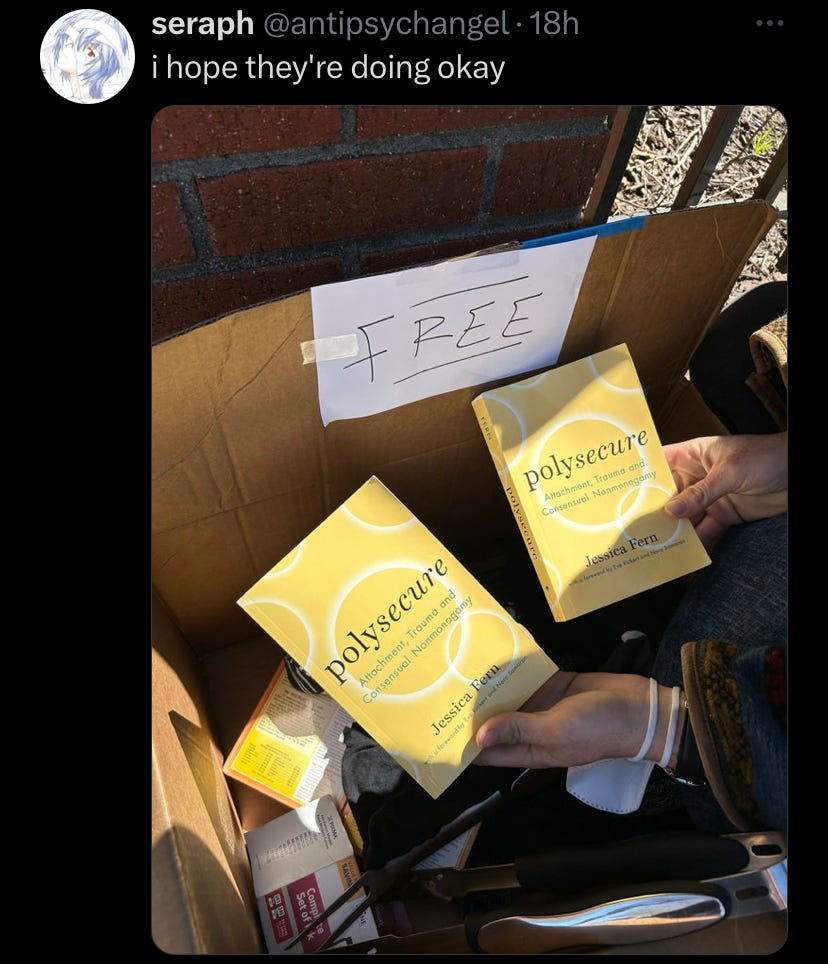
Setting aside the fact that sometimes it is…
Yes, some people are nitpicky about the difference
I said, “Baby, no attachment.”
That’s my type
Obligatory mention of jealousy with nonmonogamy
I haven't read Polysecure. But I feel like reading your essay about Polysecure was even better and now I don't have to read it
Yayyy I’ve been waiting for this essay to drop!! 🫳🏻🎤